
How to Stop Blading Chip Shots: Try the Flamingo Drill
Sep 15, 2026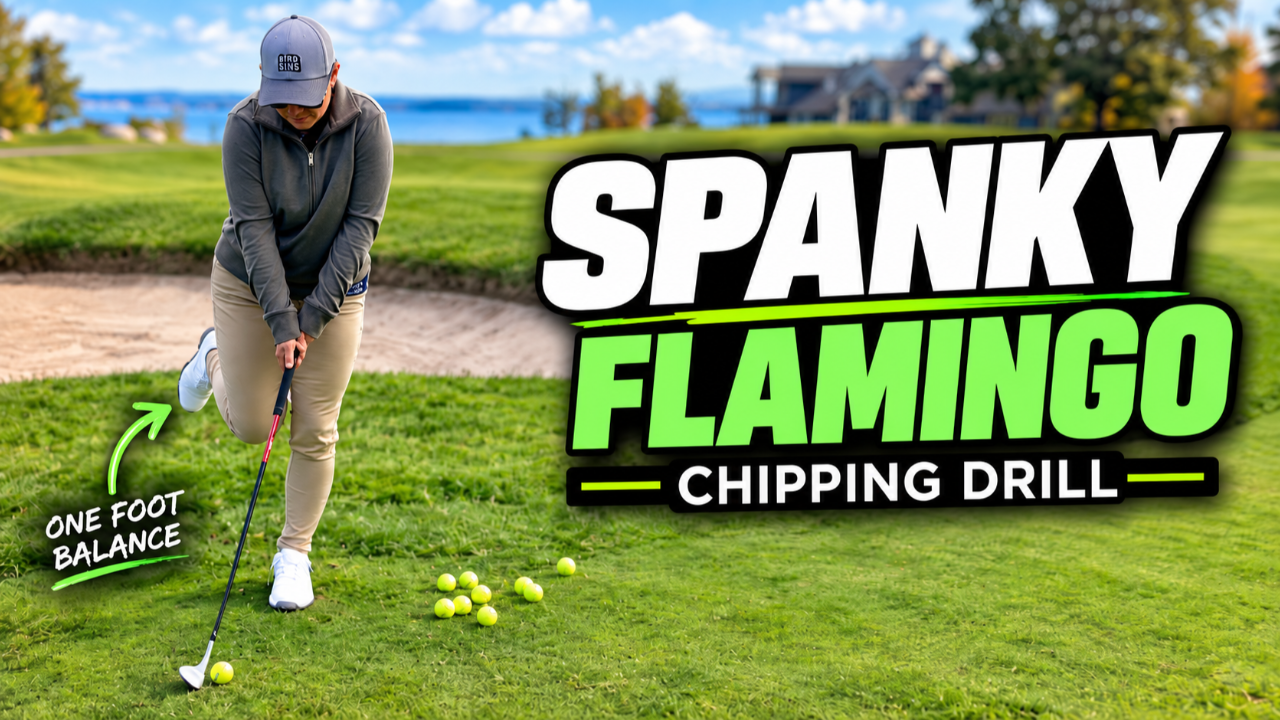
How to Stop Blading Chip Shots: Try the Spanky Flamingo Drill
You’ve got what should be a simple chip. There isn’t much trouble between you and the hole. You make your swing... and catch the middle of the golf ball with the leading edge.
Now your chip is travelling about three feet off the ground at approximately the speed of a small car.
If you’re blading chip shots across the green, one of the first things I want you to look at is your motion. Are you actually turning through the shot and allowing the club to interact with the ground? Or are you hanging back and trying to sweep the ball perfectly off the grass?
That’s exactly what this little drill is designed to help.
Meet the Spanky Flamingo Drill
While I was helping my wife, Sherry, with her chipping, she was having trouble getting comfortable with pressure on her lead foot.
So she lifted the other one off the ground.
And suddenly things started getting better.
Better body movement. Better contact. The club started actually interacting with the ground instead of sweeping across the top of the grass. Most importantly, she started producing a much better chipping motion.
The idea is simple: take the trail foot out of the equation for a few shots and let the drill teach you how to stay on your lead side, turn through the shot and make better contact with the turf.
Why Golfers Blade Chip Shots
A bladed or thin chip happens when the leading edge of the club catches too high on the golf ball. Instead of the ball popping up softly and landing somewhere near your intended target, it comes off low and hot.
Sometimes very hot.
One common reason is that the golfer is trying too hard to get underneath the ball. You see the lofted shot you want to hit and instinctively think, I’ve got to help this thing into the air.
So you hang back. Your body stops turning. Your hands try to lift or scoop the golf ball. Or you become so afraid of hitting the ground that you try to pick the ball perfectly clean.
That’s when your strike starts becoming really bad and you actually hit the ball with the bottom of the club.
The Flamingo drill takes away a lot of that uncertainty because it forces you to focus your motion around your lead side and keep your body moving through the shot.
How to Do the Flamingo Chipping Drill
You don’t need anything fancy. Grab a wedge, find a good lie around the practice green and start with a fairly short chip.
- Set up to the ball normally.
- Put your pressure onto your lead foot.
- Lift your trail foot completely off the ground.
- Stay balanced over your lead leg.
- Make a small, smooth chipping motion.
- Let your body turn through the shot.
- Allow the club to strike the ball and then interact with the grass.
Don’t worry about hitting the ball very far. You’re learning the motion, not trying to hit a heroic golf shot while standing on one leg.
The key is getting comfortable with the club actually meeting the ground in a predictable place.
Stop Being Afraid of the Ground
A lot of golfers who blade chip shots become scared of touching the turf.
They’ve hit bad chips before. They don’t want the club to dig. So they start trying to slide the club along the grass and pick the ball clean.
That can make things worse.
With a normal chip shot, we want the club to make predictable contact with the ground. The ball doesn’t need you to scoop it up. The loft on the club takes care of getting the ball into the air.
Your job is to make a good motion and deliver the club consistently.
Think:
Ball → brush the grass → turn through.
Not:
Ball → please don’t touch anything → hope.
Take the Flamingo Feeling Into Your Normal Chipping Setup
Obviously, we’re not suggesting you play every chip on the golf course standing on one leg.
Although that would make Saturday morning golf significantly more entertaining.
The Flamingo is a drill. Once you’ve hit several solid shots this way, put your trail foot back down. But don’t lose the feeling you just created.
1. Keep Pressure Toward Your Lead Side
You don’t need some huge exaggerated lean toward the target. But you also don’t want to hang back trying to help the golf ball into the air.
The Flamingo helps you feel what it’s like to stay supported on the lead side throughout the shot.
2. Let Your Body Turn
This was one of the biggest changes Sherry noticed. When she was standing on one leg, she couldn’t just sweep her arms across the grass. She had to turn.
That’s a great feeling to carry into your normal chipping motion. Your arms and club shouldn’t be operating independently while your body freezes.
3. Let the Club Interact With the Ground
Don’t make your goal: never touch the grass.
Make your goal predictable contact.
We want the club arriving at the golf ball properly and then brushing the grass as the shot continues. Once you get comfortable with that, you no longer have to make that little last-second scoop to get the ball airborne.
4. Let the Club’s Loft Do Its Job
If you’re using a wedge with loft, you’ve already got something designed to launch the golf ball.
You don’t need to add loft at the last second by flicking your hands underneath it.
Make your motion. Turn through. Hit the shot. Let the club do the lifting.
The Flamingo Fixes the Motion — But You Still Need a Chipping Method
This is where one good drill and consistently good chipping become two different things.
The Flamingo can give you a fantastic feeling for the motion. But out on the golf course you’re going to get short chips, long chips, uphill chips, downhill chips, tight lies, thicker grass and different amounts of green to work with.
So once you’ve stopped blading the ball across the green, the next step is learning how to turn that better strike into a repeatable chipping method.
The Main Pieces of a Complete Chipping Method
Build a Repeatable Setup
Your setup should make good contact easier before the club ever starts moving. That means having a consistent ball position, a stable base and enough pressure toward the lead side that you aren’t forced to make a compensation during the swing.
Control Where the Club Hits the Ground
Good chipping depends on knowing where the club is going to meet the turf. You want the strike to happen predictably around the ball, with the club brushing the grass after contact instead of bouncing into the ball or missing the turf completely.
Use Your Body Through the Shot
Your body doesn’t need to make a huge golf swing, but it does need to keep moving. A smooth turn through the shot helps the club keep travelling instead of stalling and flipping at impact.
Choose a Landing Spot
Don’t just aim at the hole and hope the ball sorts itself out.
Pick the spot where you want the ball to land, then choose the club and shot that gives you the easiest way to get it there.
Learn Carry Versus Roll
Different clubs produce different amounts of carry and roll. A lower-lofted club may spend more time on the ground, while a more lofted wedge may carry farther before releasing.
Knowing that relationship makes club selection much simpler.
Control Distance With the Size of the Motion
Once your strike becomes predictable, distance control gets much easier. Instead of changing everything from shot to shot, you can learn how different-sized motions create different carry distances.
Practice the Shot You’ll Actually Use
Perfect technique on the practice green doesn’t help much if it disappears the moment you get on the course.
Practice different landing spots, lies and distances. Learn what happens when you change clubs. Make your practice look more like golf.
Want to Make Your Chipping Consistent?
If blading one across the green is only one of the things you’d like to fix, that’s exactly why we built Consistent Chipping in 14 Days.
Instead of throwing another dozen random chipping tips at you, the program walks you through the entire process step by step.
You’ll build the motion, learn how to produce predictable contact, learn how to control the ball around the green and develop a chipping method you can actually trust when you’re playing.
Because the goal isn’t to hit one good chip on the practice green.
It’s to stand over the ball on the golf course and know what you’re trying to do.